Why bottom hygiene during dog walks matters
It’s a daily routine for every dog owner: you take a poop bag with you on your walk and collect your dog’s droppings. However, many forget an important step that can have significant health consequences for their dog – cleaning the dog’s bottom right after defecation. Your dog’s anus can be soiled with fecal residue after doing its business, which not only looks unpleasant but can also lead to infections and illnesses.
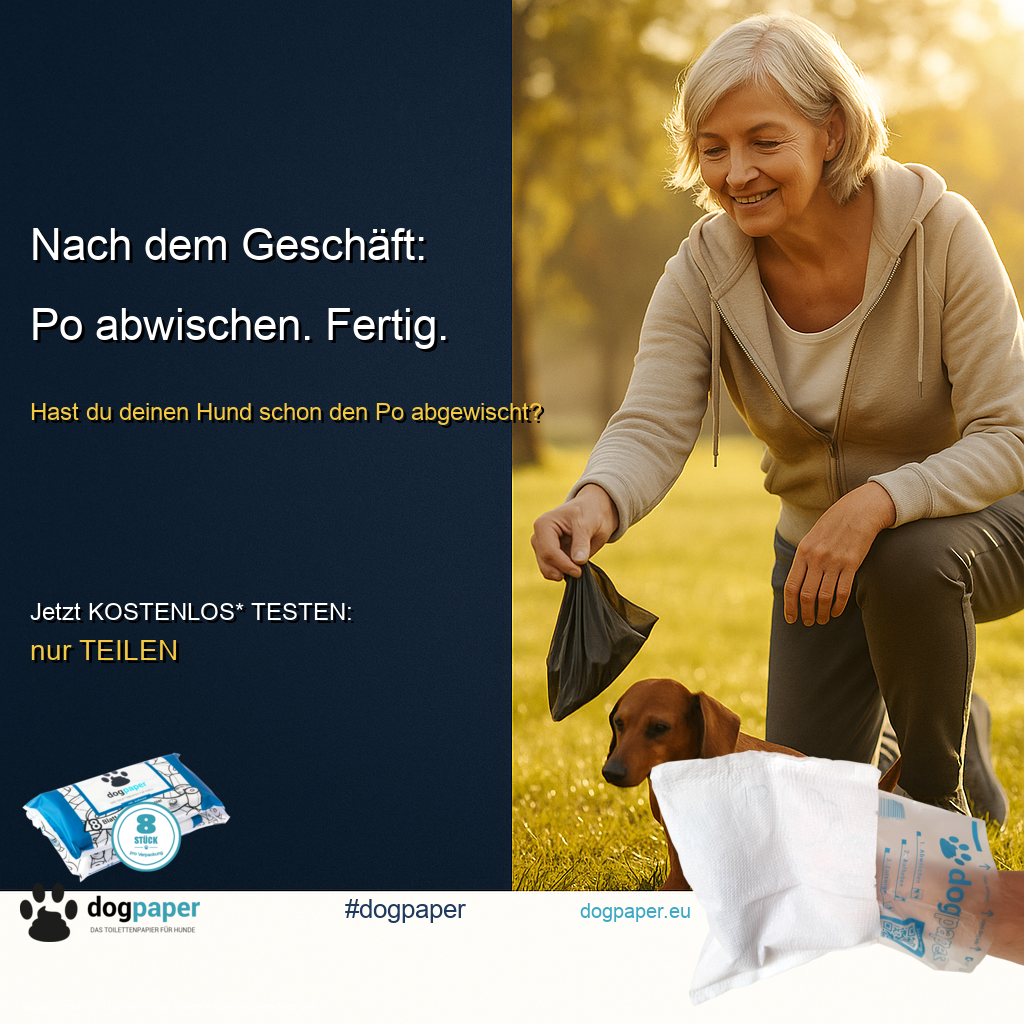
If we humans didn’t wipe ourselves after using the toilet, we would face serious hygiene problems. Why should it be different for our dog? This is exactly where dogpaper comes in: the innovative toilet paper for dogs combines two necessary steps during a walk into one practical solution.
The poop moment: Practical guide with dogpaper
Using dogpaper is simple and fits seamlessly into your usual routine. Here’s exactly how it works:
Step 1: Hand in the bag – As usual before collecting the dog’s poo, you put your hand in the bag so your hand stays clean. This is the moment when you would normally proceed directly to picking up the poo.
Step 2: Wipe the bottom – Before dealing with the dog droppings, you use the integrated hygiene paper to wipe your dog’s anus, just as you would with toilet paper. The paper removes fecal residue left behind during the dog’s defecation.
Step 3: Collect the poo – At the same moment you wipe, you’re already picking up the poo. The paper ensures that more residue is picked up from the ground than with an ordinary plastic poop bag.
Step 4: Throw away and done – You turn the bag inside out, tie it, and throw it in the nearest trash bin. One motion, two tasks completed.
Hygiene and health: What’s behind bottom cleaning
It may sound unusual, but your dog’s bottom hygiene has a direct impact on the health of your entire family. Fecal residue in the fur around the anus quickly becomes a carrier of dirt and potential pathogens. The particular danger: roundworms and roundworm eggs, whose traces are barely visible to the naked eye.
Your dog can pick up roundworm eggs by sniffing or licking near other dogs’ fecal piles. If these eggs then enter the human body, they can actually hatch and cause infections. Regular wiping of your dog’s anus after defecation significantly reduces these risks.
Additionally, fecal residue remaining in the fur around the anus inevitably ends up in your home – on carpets, sofas, and other surfaces. With dogpaper, you close this gap in everyday dog hygiene.
More than just practical: The USP of dogpaper
dogpaper is the world’s only product that combines hygiene paper and a dog poop bag in one solution. While ordinary poop bags serve only one purpose – collecting the poo – dogpaper offers a holistic approach to bottom hygiene during walks.
The advantage is obvious: you save time, don’t need a separate solution for bottom cleaning, and get a more environmentally friendly poop bag at the same time. The paper bag can even be flushed down the toilet after use – the inner plastic bag is then recycled separately. This is completely impossible with ordinary poop bags.
Integrate dogpaper into your walking routine
Remember on your next Sunday walk: after your dog does its business, you only need dogpaper. Hand in, wipe, pick up, throw away – done. It’s a small habit with a big impact: for your dog’s health, for your family, and for the cleanliness of your home.
With dogpaper, you establish a routine and conscious approach to handling your dog’s excretions that focuses on hygiene from the start – not as an afterthought, but as an integral part of your daily walk.